Aurora seen from space.
 mastodon 4.8.0-nightly.2026-10-06
"The most beautiful thing we can experience is the mysterious. It is the source of all true art and science" - Albert Einstein
Metronomes started randomly synchronize after a short period of time as they influence each other through the side-to-side motion of their shared base.
Source: UCLA Physics & Astronomy
https://demoweb.physics.ucla.edu/content/160-spontaneous-synchronization
Timelapse of a "Glory of Texas" cactus (Thelocactus bicolor) blooming.
📽️: Petr Vodička / CC BY-SA 4.0
The fascinating way soap bubbles freeze.
📽️: Lorie Shaull | CC BY 2.0
A timelapse showing the incredible movement of a growing vine, exhibiting both nastic movement to find, and then a thigmotropic response to grasp and hold.
Credit: Roger P. Hangarter
A meteor, the Milky Way and Mount Fuji captured by photographer Hayata Suzuki.
Spectacular timelapse of the Milky Way galaxy and a phenomenon known as airglow seen from the International Space Station.
Credit: NASA Johnson
Relative rotation speed and axial tilts of the planets.
Credit: Dr James O'Donoghue
Time-lapse of the Sun circling the horizon at the South Pole during early March.
Video credit: Robert Schwarz
Source: https://vimeo.com/208466944
A ladybird beetle spreading its wings captured with a high-speed camera. In real-time wing deployment from the fully folded state takes less than 0.1 seconds.
Video credit: University of Tokyo / Saito et al. 'Investigation of hindwing folding in ladybird beetles.' DOI: 10.1073/pnas.1620612114.
https://www.pnas.org/doi/full/10.1073/pnas.1620612114
An owl gliding through a cloud of helium-filled soap bubbles reveals wingtip and tail vortices.
Video credit: Usherwood et al.
Source: https://journals.biologists.com/jeb/article/223/3/jeb214809/223686/High-aerodynamic-lift-from-the-tail-reduces-drag
These incredible ibex defy gravity climbing a near-vertical dam in search of nutritious salt.
Video credit: BBC
The biggest volcanic eruption ever seen from space, captured by two different satellites on January 15, 2022.
https://en.wikipedia.org/wiki/2022_Hunga_Tonga%E2%80%93Hunga_Ha%CA%BBapai_eruption_and_tsunami
These two photographs are separated by only 66 years.
The LI-900 silica tiles used on the Space Shuttle were such poor heat conductors you could grab them with bare hands seconds after pulling them from a 2200 degree oven.
Source: http://bit.ly/2I7k683
Listen to the world's loudest bird, the Amazon's white bellbird. It has a call that peaks at 125.4 decibels, louder than a chainsaw or jackhammer.🔊
Credit: Anselmo d'Affonseca
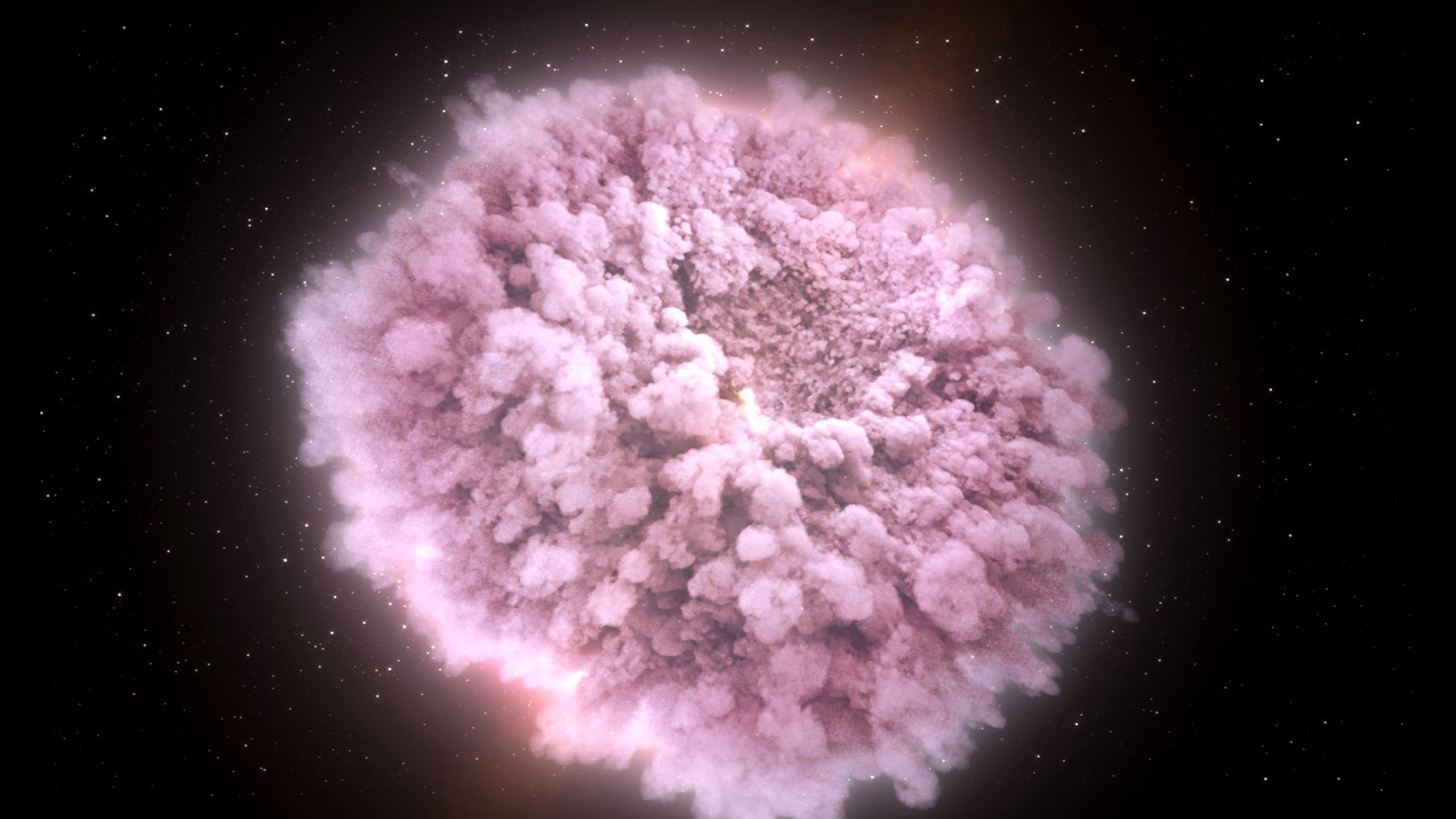
A thousand times brighter than a typical nova, a kilonova occurs when two neutron stars, or a neutron star and a black hole, collide.
Further reading: https://www.livescience.com/kilonovas-rain-gold-on-the-universe.html
These rows are perfectly horizontal and are not moving. A mind-bending anomalous motion variation of the Café wall illusion by Akiyoshi Kitaoka.
Source: http://www.psy.ritsumei.ac.jp/akitaoka/motion30e.html
Apollo 17 lifts off from the Moon on December 14, 1972, the last time humans visited the lunar surface and traveled beyond Earth's orbit.
The speed of light visualized on a cosmic scale.
Credit: @Physicsj@mastodon.online
The amazing golden color of these scarab beetles (Chrysina resplendens) is not a result of pigmentation or actual metal, but ≈70 microscropic chitin layers of decreasing thickness that reflect light to produce a metallic effect.
Video credit: insecthaus_adi/ig
Source: https://www.instagram.com/p/BVaHvmIhjbb/
Further reading: https://www.eurekalert.org/news-releases/882153
Zoom in on the Andromeda Galaxy with Hubble. What looks like a smudge of light to the unaided eye is actually a vast galaxy containing an estimated 1 trillion stars.
Credit: ESA/Hubble & NASA
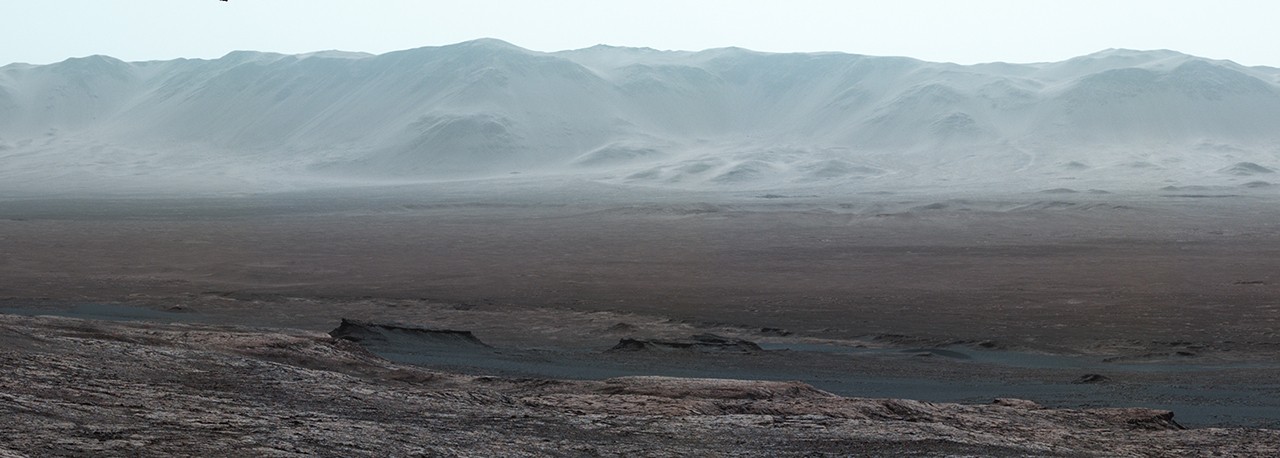
A panoramic view from the surface of Mars captured by Curiosity rover.
Credit: NASA/JPL-Caltech/MSSS
Source: https://mars.nasa.gov/resources/21468/wide-angle-panorama-from-ridge-in-mars-gale-crater/
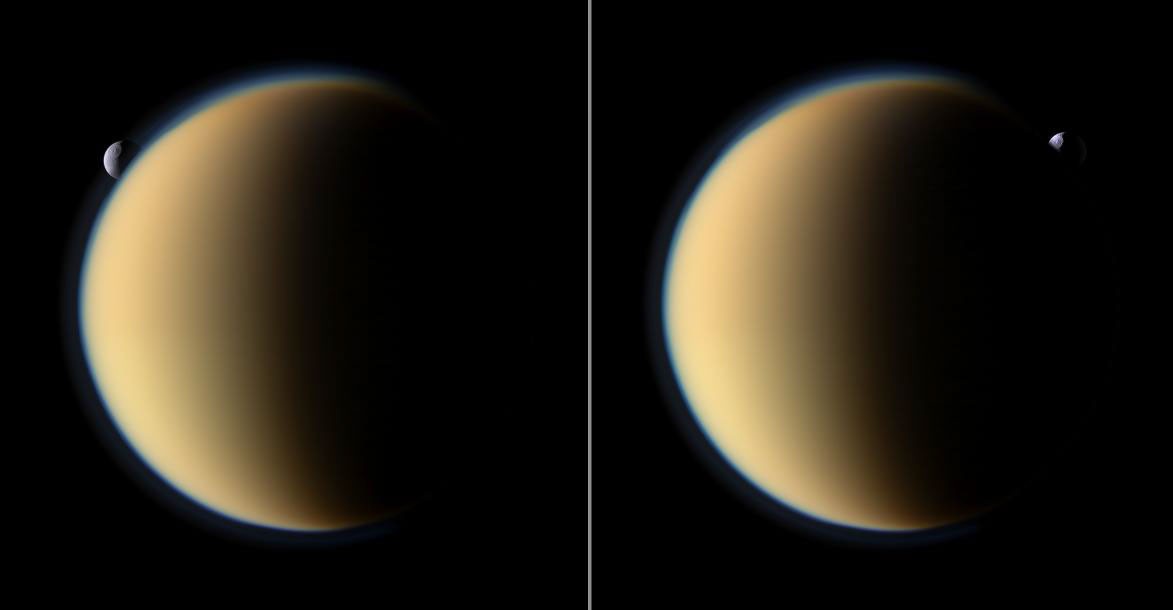
Saturn's heavily cratered moon Tethys slipping behind atmosphere-shrouded Titan captured by the Cassini spacecraft.
Credit: NASA/JPL/SSI
Source: https://solarsystem.nasa.gov/resources/14811/tethys-slips-behind-titan/
@ProcessParsnip@mastodon.ie Thank you, added to post